REVIEW · KATHMANDU
Kathmandu: Private/Group Tour to 7 UNESCO Sites with Lunch
Book on Viator →Operated by Himalayan Social Journey · Bookable on Viator
Seven UNESCO sites, one tight day. This Kathmandu Valley tour strings together the major monument zones—three Durbar Squares plus Swayambhunath, Pashupatinath, Boudhanath, and Changu Narayan—so you get the full UNESCO hit without spending days hopping between neighborhoods. I especially like the hotel pickup and drop-off, because Kathmandu traffic and distances can turn a “quick outing” into a long slog.
My other favorite part is the well-planned route that keeps moving while still giving you enough time at each stop to actually look and ask questions. One thing to consider: entrance fees are not included, and they add up fast across the seven sites, so budget for the full total before you go.
In This Review
- Key things that make this UNESCO day tour work
- Why Kathmandu Valley’s UNESCO sites feel different than a normal city tour
- Price and logistics: what you pay on top of the $50
- Your 7–8 hour day: how timing and transport actually feel
- Stop 1: Swayambhunath (Swayambhu Mahachaitya) and the Monkey Temple viewpoint
- Stop 2: Kathmandu Durbar Square for palaces, courtyards, and royal remnants
- Stop 3: Patan Durbar Square—where Buddhism and Hinduism overlap
- Stop 4: Changu Narayan Temple—hilltop views and ancient roots
- Stop 5: Bhaktapur Durbar Square—medieval architecture you can read with your feet
- Stop 6: Pashupatinath Temple—Hindu pilgrimage by the Bagmati River
- Stop 7: Boudhanath Stupa—one of the world’s largest, with Tibetan monastic life nearby
- Lunch and comfort breaks: what’s included (and what to expect instead of a full meal)
- The guide experience: why communication matters on a UNESCO loop
- Weather and stamina: the two things that can make or break this day
- Who this tour is best for
- Should you book this Kathmandu 7-UNESCO day tour?
- FAQ
- FAQ
- What’s the duration of the tour?
- Do I get hotel pickup and drop-off?
- Does the tour include lunch?
- Is the guide included?
- Are entrance fees included in the $50 price?
- How much are the entrance fees?
- How many people are in the group?
- Is there transportation included?
- What do I need to know about the tour ticket?
- What happens if the weather is bad?
- Can I cancel for a refund?
Key things that make this UNESCO day tour work
- 7 to 8 hour “greatest hits” route across Kathmandu Valley’s UNESCO monument zones
- Hotel pickup and drop-off to reduce stress and save time in a traffic-heavy city
- English-speaking guide and organized timing that helps you see more with less confusion
- Smallish group size (up to 25), which usually feels easier than packing in with a huge crowd
- Snack-style included lunch (croissant, muffin, danish, cookies, banana, juice) plus bottled water
- Mobile ticket option and shared transport for an easier day
Why Kathmandu Valley’s UNESCO sites feel different than a normal city tour
Kathmandu Valley UNESCO is not one museum stop. It’s a set of monumental neighborhoods and sacred places that show how Buddhism and Hinduism shaped daily life for centuries. The places are spread out, and the spacing matters: you don’t want to waste half your day figuring out transport between sites.
This tour’s idea is simple and smart. You use one guide, one schedule, and one shared ride to cover all seven UNESCO locations in one go. That means you can focus on the details that make each site worth your time—stone work, temple layouts, stairways, courtyards, and the sacred rhythm around major shrines.
Also, the price point is low for Kathmandu if you compare it to hiring a private driver for the same loop. You’re paying mostly for the guide and routing support. The big catch is the entrance fees, which are separate for all but some areas.
You can also read our reviews of more private tours in Kathmandu
Price and logistics: what you pay on top of the $50
The tour price is $50 per person, and it includes pickup/drop-off, a shared vehicle, an English-speaking guide, government tax/service charge, and bottled water plus a snack-lunch set.
Then comes the part you must plan for: entrance fees for the seven UNESCO sites are not included.
Based on the listed amounts:
- 4 sites at $20 per person: Patan Durbar Square, Boudhanath, Swayambhunath, Pashupatinath
- 3 sites at $24 per person: Kathmandu Durbar Square, Changu Narayan, Bhaktapur Durbar Square
That’s an estimated total entrance cost of $152 per person, on top of the $50 tour price—so around $202 all-in before personal spending.
If you’re the kind of traveler who hates surprise costs, budget early. If you like structured sightseeing and want to knock out UNESCO in one day, the math usually makes sense.
Your 7–8 hour day: how timing and transport actually feel
The tour runs about 7 to 8 hours, and most of that time includes travel between sites. You’ll also get a limited amount of time at each stop, so don’t plan on “slow museum mode.”
Here’s the reality: Kathmandu’s UNESCO sites reward quick, focused looking. You’ll get better results if you arrive ready with good walking shoes, a water plan, and a few questions for your guide—because the guide’s explanations matter most when you’re standing in front of the stone and layout.
Group size tops at 25, which helps with flow. And since this includes hotel pickup and drop-off, you aren’t negotiating finding meeting points midday.
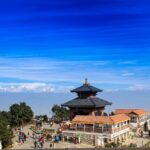
Stop 1: Swayambhunath (Swayambhu Mahachaitya) and the Monkey Temple viewpoint
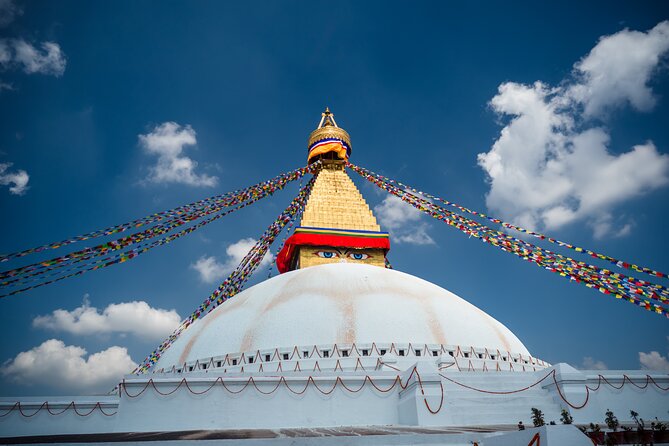
Swayambhunath is one of the best “orientation” stops in Kathmandu Valley. You’re visiting a Buddhist stupa complex about 2,600 years old, and it sits high enough that it looks over the valley.
It’s also known as the Monkey Temple because there are hundreds of monkeys around. That sounds like a fun nickname—and it is—but treat it as part of the site rules. Keep an eye on your belongings and be mindful as you move around stairways and platforms.
Why it’s worth your time:
- The viewpoint helps you understand where the rest of the day’s sites sit in relation to the valley.
- The stupa setting gives you a strong sense of how Buddhism has a public, everyday presence here.
Time note: expect about 35 minutes. With that schedule, you’ll want to prioritize the main viewpoints and the stupa surrounds rather than getting lost in side corners.
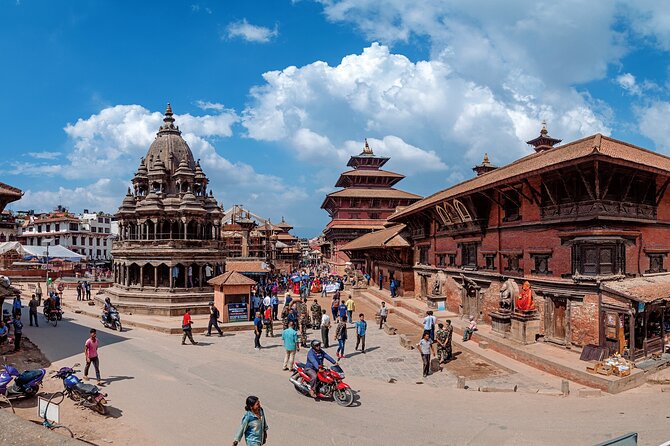
Stop 2: Kathmandu Durbar Square for palaces, courtyards, and royal remnants
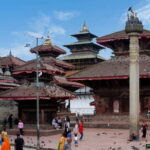
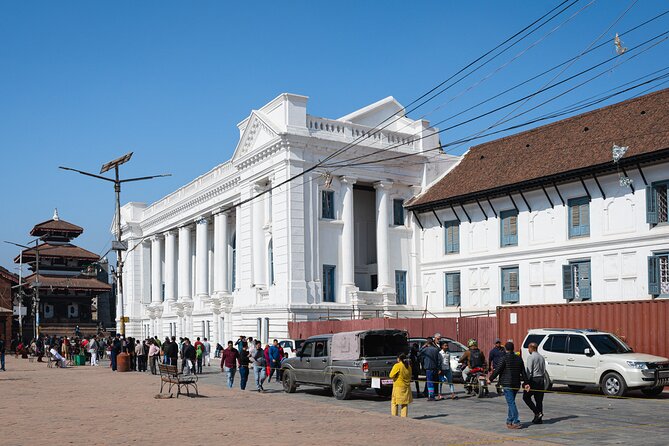
Kathmandu Durbar Square is in the old city center and functions like a historical stage. The square is surrounded by palaces, courtyards, and temples, and it’s “pleasant” in the practical way: you can walk in different directions, look up at carvings, and feel how the complex works as a living heritage zone rather than a single monument.
Why this stop matters:
- It anchors your understanding of Kathmandu’s historic urban core.
- The layout makes it easier to spot the difference between major temples and the palace-like structures around them.
Time note: plan on about 1 hour. That’s enough to see the highlights, but not enough to read every plaque. If you want the most meaning, ask your guide what to notice—like how courtyards and temple groupings change the way people move.
Entrance fees are not included here, so remember it’s one of the $24 sites.
You can also read our reviews of more tours and experiences in Kathmandu
Stop 3: Patan Durbar Square—where Buddhism and Hinduism overlap
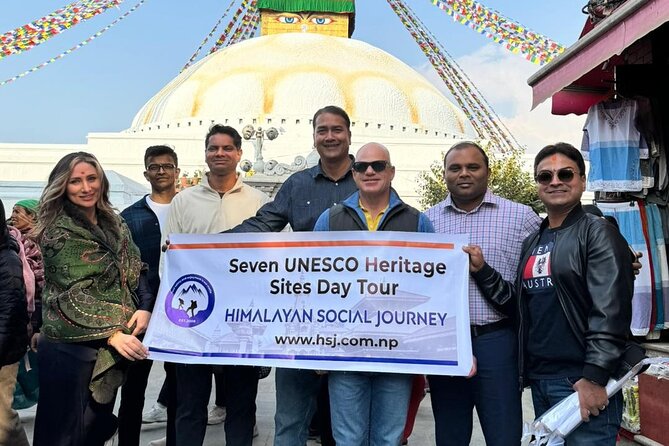
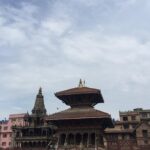
Patan Durbar Square is about 5 km from Kathmandu. This is another “walkable UNESCO neighborhood” stop rather than a single building. It’s described as a fusion zone where Buddhism and Hinduism meet, which you’ll notice in the way temples and iconography relate to one another.
What you’ll enjoy if you like art and architecture:
- Patan often feels like the stonework is doing most of the storytelling.
- The durbar square context helps you see religious influences not as separate topics, but as overlapping visual systems.
Time note: about 1 hour 30 minutes, the longest slot after Bhaktapur. That extra time helps if you pause often or want to trace how spaces are arranged.
Also, this is one of the $20 entrance-fee sites.
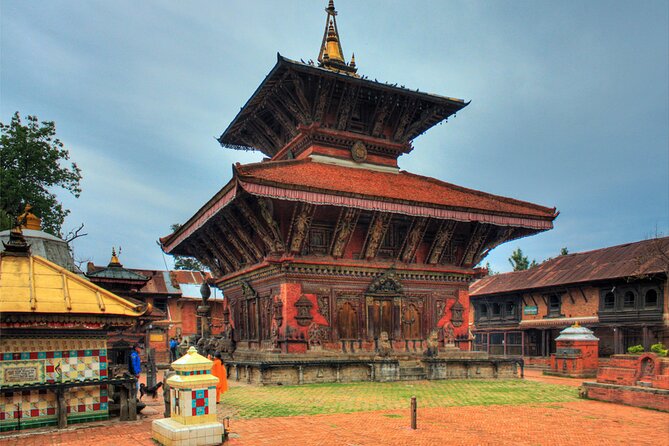
Stop 4: Changu Narayan Temple—hilltop views and ancient roots
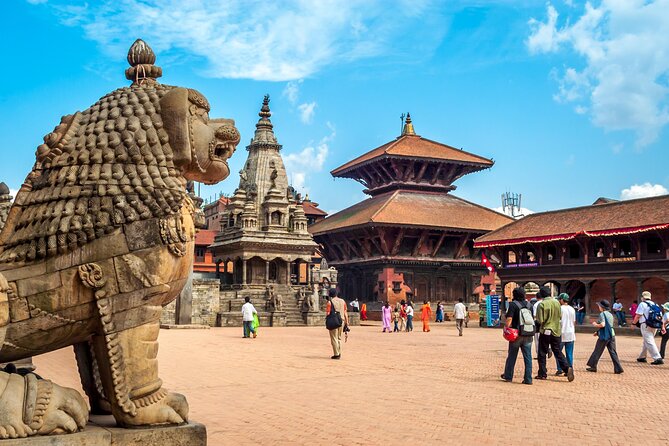
Changu Narayan Temple is located on a hilltop in the village of Changu Narayan, near Bhaktapur. This stop leans into “old temple” vibes: it’s believed to date back to the 4th century during the Lichhavi dynasties.
You’ll probably feel the contrast right away. Unlike the bigger durbar squares, this feels more focused. It’s also a nice breather because the walking is more about getting to and around the temple area than exploring a large urban complex.
Time note: around 25 minutes, so you’re doing highlights. If the hilltop climb or stairs feel tiring, just pace yourself and use the time well for photos and a look at the temple’s details.
Entrance fee applies here as one of the $24 sites.
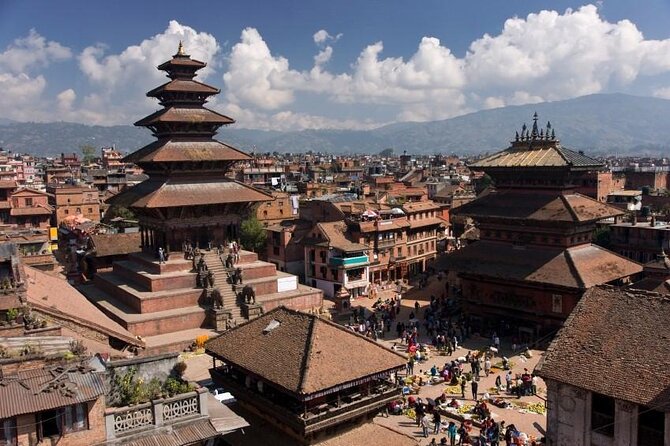
Stop 5: Bhaktapur Durbar Square—medieval architecture you can read with your feet
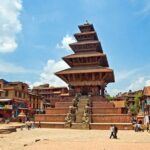
Bhaktapur Durbar Square is the one that many people love for the “kept intact” feeling. It’s in Bhaktapur city and is known for well-preserved medieval architecture, including temples and palaces.
Why this stop works:
- You can walk through parts of the complex and feel the scale of buildings that still hold their shape and purpose.
- The medieval urban setting makes the UNESCO status feel tangible.
Time note: about 2 hours, which is generous for a loop tour. Use that time to look at street-level carvings and the way temples fit into the square.
Entrance is not included here, and it’s one of the $24 fee sites.
Stop 6: Pashupatinath Temple—Hindu pilgrimage by the Bagmati River
Pashupatinath is a must for many visitors. It’s a legendary Hindu temple complex, and it sits on the bank of the sacred Bagmati River, which flows down toward the Ganges.
The religious significance is the headline, but you’ll also notice the setting. River-edge temples change the feel of the visit. You’re not only looking at architecture; you’re watching how the sacred space relates to water and daily life.
Time note: about 1 hour. This is enough to see the main areas and take in the atmosphere, though you’ll still want to keep an eye on schedule because the loop continues.
Entrance fees are not included and this is another $20 site.
Stop 7: Boudhanath Stupa—one of the world’s largest, with Tibetan monastic life nearby
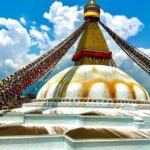
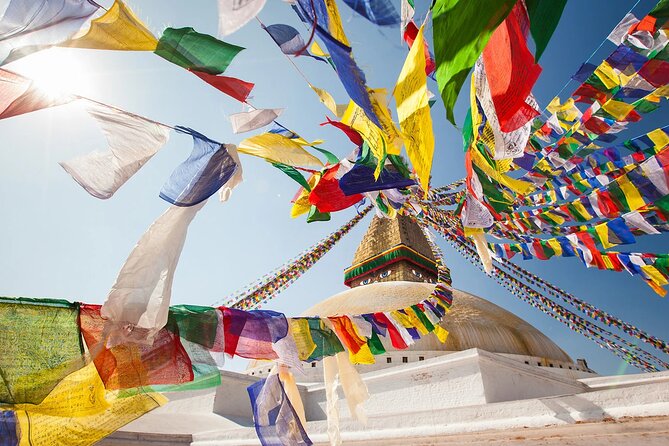
Boudhanath is described as one of the largest stupas in the world, with construction going back to the 4th century. It’s also known for a Tibetan village feel in the surrounding area, where you’ll find Tibetan monasteries and related spaces.
If you like cultural texture, this is the stop that often delivers it most clearly. The stupa dominates the scene, but the nearby monasteries add context for how Buddhism shows up here in community form.
Time note: about 40 minutes. That’s tight for a huge monument, so prioritize the main stupa viewing areas and any guided explanations about the stupa and its setting.
Entrance is not included here and it’s one of the $20 sites.
Lunch and comfort breaks: what’s included (and what to expect instead of a full meal)
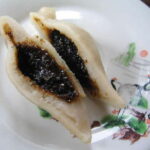
Lunch is included, but it’s not a restaurant lunch in the typical sense. You’ll get a snack set: croissant, muffin, danish, cookies, banana, and juice, plus bottled water.
For most people, that works fine for an active day with a tight schedule. But if you need a proper sit-down meal or you’re a big eater, plan to treat these snacks as your base and consider grabbing extra food at one of the easier points later in the day. (Personal expenses aren’t included.)
Comfort tip: take a moment before leaving each site to hydrate. With all the stairways, uneven paths, and crowd flow, you’ll feel better if you snack little and often instead of trying to “save hunger” until the end.
The guide experience: why communication matters on a UNESCO loop
This tour uses an English-speaking guide, and that’s not a small detail. On days like this, you’re visiting sites with layered meaning. When the guide points out what to watch for—temple layout, religious function, or how a square differs from a stupa—it turns a fast look into something that sticks.
The tour format also makes the guide’s organization important. With seven stops, the schedule is the backbone. The best guides help you move at the right pace, keep you on time, and answer the questions you’ll only think to ask when you’re standing there.
And because the group is capped at 25, the guide can usually manage questions without feeling swallowed by the crowd.
Weather and stamina: the two things that can make or break this day
This experience requires good weather. In practical terms, that means less rain, fewer slippery surfaces, and smoother visibility for viewpoint moments like Swayambhunath.
The tour also lasts 7 to 8 hours with travel between sites. If you’re sensitive to walking, or if you hate repeated stair climbs, you might feel rushed. This isn’t a slow photo-stroll tour; it’s a structured highlights day.
You can still enjoy it—just come prepared:
- wear comfortable shoes you trust on uneven surfaces
- carry a small water plan even though water is included
- keep expectations realistic about time at each UNESCO monument
Who this tour is best for
This is a strong choice for:
- first-timers who want the main Kathmandu Valley UNESCO sites without juggling transport
- travelers who like clear structure and an efficient day plan
- anyone who wants to ask questions and learn while moving between locations
- people who don’t want to hire multiple drivers for a multi-stop itinerary
It may be less ideal for:
- anyone with very limited mobility or very low walking tolerance (the sites involve stairs and uneven areas)
- travelers who want long stays at one or two sites and don’t like crowds moving through
- food-only planners who need a full sit-down lunch
Should you book this Kathmandu 7-UNESCO day tour?
I think it’s worth booking if your goal is clear: see all seven UNESCO locations in one day with a guide and pickup. The included snack set and bottled water help you keep moving, and the schedule is built for people who want results.
Before you book, do the math and check your priorities:
- If you hate entrance fees or you budget tightly, this one can feel pricey once you add the separate site costs.
- If you want the most UNESCO coverage for one ticketed day, this is one of the most practical ways to do it.
My decision rule is simple: if you’re in Kathmandu for a short time and you want a guided “greatest hits” loop, book it. If you have extra days and you’d rather linger, consider mixing fewer sites with more free time.
FAQ
FAQ
What’s the duration of the tour?
It runs about 7 to 8 hours total, including travel time between the seven UNESCO sites.
Do I get hotel pickup and drop-off?
Yes. Hotel pickup and drop-off are included.
Does the tour include lunch?
Yes. Lunch is included as a snack set: croissant, muffin, danish, cookies, banana, and juice, plus bottled water.
Is the guide included?
Yes. The tour includes an English-speaking guide.
Are entrance fees included in the $50 price?
No. Entrance fees are not included for all seven sites. There are separate fees listed for different groups of sites.
How much are the entrance fees?
The tour lists entrance fees of $20 per person for Patan, Boudha, Swayambhu, and Pashupati, and $24 per person for Kathmandu Durbar Square, Changu Narayan, and Bhaktapur Durbar Square.
How many people are in the group?
The tour has a maximum of 25 travelers.
Is there transportation included?
Yes. You’ll use sharing transportation as part of the tour.
What do I need to know about the tour ticket?
You’ll receive a mobile ticket.
What happens if the weather is bad?
The tour requires good weather. If it’s canceled due to poor weather, you’ll be offered a different date or a full refund.
Can I cancel for a refund?
Yes. You can cancel up to 24 hours in advance for a full refund. If you cancel less than 24 hours before the start time, it isn’t refunded.